
UK Online Casino Game Shows: How to Compare Them
 Available in GB
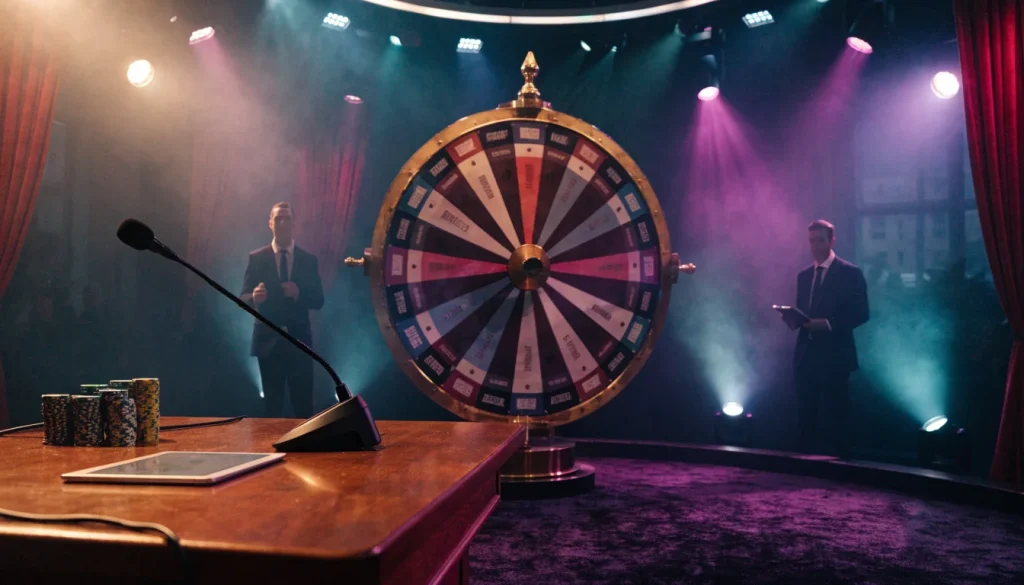
A category name can point to a kind of casino experience, but the title’s own description and rules explain what it offers.
What “live game show” means when you search for an online casino
“Live game show” is a category phrase, not a precise description of a particular casino product. It signals that you are looking for something presented as both a casino game and a show, but it does not tell you exactly what a site offers. The label alone cannot establish how a game works, what you will see on screen, whether there is a presenter, or what choices are available to you.
That distinction matters when comparing online casinos. A search result may use language such as “casino game shows” to describe a broad section, while a lobby may use the same label for a particular title or group of titles. Those uses are not interchangeable. A category name can help you find the kind of experience you have in mind; it is not a substitute for the product’s own description and rules.
If you are looking for the best online casino game shows in the UK, start by treating “best” as a question about what suits you, not as an objective ranking promised by the wording. Without a defined title and verifiable details, there is no sound basis for declaring one show better than another. The useful first step is to identify what you mean by “live” and “game show”, then check whether the product being offered matches that expectation.
A broad label, not a set of guaranteed features
The words can suggest a particular style of entertainment, but suggestion is not confirmation. “Live” might be read as a claim about how content is presented; “game show” might bring to mind a familiar kind of programme. Neither word, on its own, confirms the technology, the presence of a host, the pace of play, the rules, or the way a result is determined. Those details need to come from the specific game’s information, rather than assumptions attached to its category.
UK Online Casinos With No Limits: What It Means · Best Barcrest Online Casinos UK: Provider Checks
This is especially important because people can use “live casino game shows” to mean different things. One person may be looking for a game that feels like a television show. Another may mean any casino product displayed in a live section. Someone else may be trying to find a particular title they have heard about. The same phrase can therefore lead to different expectations, even before you reach an operator’s site.
A category page may also group products together without telling you how similar they are. A shared label does not prove that the games have the same presentation, rules or interaction. Nor does it show that every product under that label is available to every customer. Availability and descriptions can vary between sites, so the label is best treated as a starting point for checking, not as a complete specification.
Separate the category from the individual product
When you see a reference to online casino live game shows, ask whether the page is describing a whole category or naming a specific product. If it is a category, look for the title of the game you would actually open. If it names a product, look for that product’s own rules and information. This helps prevent a general description from being mistaken for a promise about every game in the category.
The distinction also helps with claims about features. A page may describe an experience in promotional terms, but that language is not enough to establish what happens during play. Look for clear information about the game itself, including its rules and any conditions relevant to your decision to play. If important details are absent or unclear, do not fill the gaps with what you think a show of that kind normally does.
The same care applies to the word “live”. It may be used as part of a product label or as a description of presentation, but you should not infer more than the page explicitly states. In particular, do not assume that a game is broadcast in real time, that a person is hosting it, or that you can interact with anyone. Those are specific product claims, not facts supplied by the broad category name.
Do
- Identify the specific game title
- Read the product’s own rules
- Check for clear, concrete information
Don’t
- Rely on category labels alone
- Assume features based on a title
- Fill information gaps with assumptions
What to check before choosing
A useful comparison begins with concrete details rather than a ranking headline. Find the game’s full name and read the rules that apply to it. Check how the operator describes the product, what the game screen and help information say, and whether the terms are consistent across those places. If an explanation depends on vague phrases such as “show-style” or “live experience”, seek a more precise account before deciding whether it fits what you want.
Pay attention to the difference between what is promised and what is merely implied. A page might use images, a name or a short description to create an impression. None of those elements should be treated as proof of a feature unless the product information confirms it. If you cannot tell what you would be playing, how the rules work or what a term means in context, that uncertainty is a reason to pause rather than guess.
You can also ask yourself what you actually want from the category. Are you seeking a particular presentation, a specific game, or simply an alternative to other casino games? The answer will affect what information matters. If you have a particular title in mind, verify that exact title rather than relying on a broad page about game shows. If you are browsing more generally, compare the individual products on their own descriptions and rules.
Do not let a “best” label do the comparison for you. A ranking is only useful if its criteria are clear and the details behind it can be checked. A list may reflect editorial preference, promotional placement or a changing selection rather than a stable assessment of the games themselves. Without a transparent basis, “best” is a claim to examine, not a conclusion you need to accept.
EGT Online Casinos UK: Checking Amatic Games
Why familiar expectations can mislead
The phrase “game show” carries associations from television and other entertainment. Those associations may help explain what you hope to find, but they do not establish that an online casino product follows the same format. You might expect a host, audience participation, rounds, prizes or a particular visual style. Unless the product’s own information confirms those elements, they remain expectations rather than verified features.
Likewise, the word “casino” does not tell you which kind of game sits behind a show-style presentation. A category label does not establish the game’s rules or how a result is produced. Do not infer that two products share a format simply because both are described as shows, or that a product works in a particular way because another game you have seen used that approach.
This can matter when deciding whether a game is suitable for you. If you prefer to understand the rules before playing, take time to read them rather than relying on a promotional summary. If the presentation makes it difficult to find the relevant information, or the rules do not answer your questions, you can leave the game unopened. You do not need to make a deposit just to discover whether a label matched your expectations.
Reading casino descriptions carefully
Casino sites may use related phrases such as “live game shows”, “game show casino” or “online casino game shows”. These expressions can point towards a similar area of interest, but wording alone does not confirm that two sites offer the same products. Nor does it establish that a product described on one site is available on another. Look for the actual game name and the details shown by the operator you are considering.
Attention: A category heading is not a guarantee that a particular title is currently accessible or available to every customer.
A category heading can be useful for navigation, but it is not a guarantee that the section contains a particular title or that every listed item is currently accessible. Product menus and descriptions may change. If you already know what you are looking for, confirm it in the operator’s current game information rather than relying on an old mention, a search snippet or a general overview.
Be cautious with claims that bundle several ideas together. A phrase such as “interactive live entertainment” may sound specific while leaving unanswered what the product actually does. Ask what the words mean in practice and look for an explanation in the rules. If the information does not explain a feature clearly, do not assume that the feature exists.
Make the category work for your decision
The phrase “live game shows” can be a helpful way to narrow your interest, but it should not make the decision for you. Treat it as a broad signpost: identify the product, check its own description, and read its rules before staking money. That approach is more reliable than choosing from a label or a headline alone.
It also keeps separate three questions that are easy to blur together: what kind of category a site claims to offer, what a particular product is called, and what that product actually does. The first is a broad description; the second identifies an item; the third requires product-specific information. A confident answer to one does not automatically answer the others.
Amatic Online Casinos in the UK: Games and Operators
If you cannot establish what is being offered, there is no need to resolve the uncertainty by taking a chance. You can compare other descriptions, return when the information is clearer, or decide that the category is not for you. For a search centred on game-show-style casino products, the sensible standard is straightforward: let the product’s own details set your expectations, and do not treat the category name as evidence of features that have not been explained.
Top online casinos in the UK
- NightWinBonus: £900 + 400 free spins · Payout speed: 1-3 business days
- SpinFormulaBonus: 550% Up To £15,000 + 550 FS · Payout speed: 1-3 business days
- EvoSpinBonus: 125% up to €2500 + 125 Free Spins · Payout speed: 1-3 business days
- DieselwinBonus: Welcome Pack 250% up to £4000 + 200 FS · Payout speed: 1-3 business days
- x3betBonus: Welcome Pack 100% Up to £1.000 + 200 Free Spins · Payout speed: 1-3 business days
- NightLuckBonus: Welcome Pack + 805% Up To 6400€ + 280 FS · Payout speed: 1-3 business days
The UK licensing framework behind online casinos with live shows
When you compare online casinos that advertise live game shows, the first regulatory question is not where a studio or server is located. It is whether the business offering remote gambling to customers in Great Britain holds the relevant UKGC licence. The Gambling Commission regulates commercial gambling in Great Britain, including remote gambling, and its reach does not depend on where the equipment supporting a service is kept.
That distinction matters because a casino’s website, its business, and the equipment used to deliver a game may be in different places. A remote operator cannot avoid the British licensing requirement simply by locating key equipment overseas. For you, the practical point is that the operator serving you is central to the licensing question; the physical location of the technology is not a substitute for checking who is offering the gambling.
The Gambling Commission is the sole regulator for commercial gambling in Great Britain, issuing operating licences to businesses and personal licences to individuals.
The Commission is the sole regulator for commercial gambling in Great Britain. It issues operating licences to businesses and personal licences to individuals working in relevant roles. These are different kinds of authorisation: one applies to the business carrying on the activity, while the other applies to an individual. A casino’s claim that a game or service is supplied by another company does not, by itself, answer whether the casino operator has the licence needed to serve customers in Great Britain.
The operator is the key point of reference
A live-show label describes how a casino presents a product to customers; it does not establish the regulatory status of the site carrying it. A company may be involved in supplying a product or technology, while a separate business makes the gambling available to customers. When you are assessing an online casino, focus on the business that accepts you as a customer and offers remote gambling, rather than treating a provider name or a production location as evidence of the operator’s authorisation.
This is especially useful when a casino’s promotional material gives prominence to a studio, a presenter, a named show, or an external supplier. Those details may help identify what the casino is advertising, but they do not replace the operator’s own licensing position. The business offering remote gambling to people in Great Britain is the relevant starting point for understanding whether the service falls within the Commission’s framework.
The same principle applies if a site suggests that its technology is hosted elsewhere. The location of key equipment does not remove the requirement for a remote operator serving Great Britain consumers to hold the relevant licence. A site’s technical arrangements and its regulatory responsibility are separate questions. You do not need to infer the operator’s status from an equipment address, a studio location, or a supplier’s description of its role.
Amatic Online Casinos in the UK: How Access Works
Nor does the presence of a familiar game-show brand prove that every site carrying it is authorised. Product branding is not a licence, and the name of a supplier is not a substitute for the business’s operating authorisation. Keep those questions separate: what is being offered, which business is offering it, and whether that business is licensed for the relevant market.
What a UKGC licence does—and does not—tell you
A UKGC licence is part of the regulatory framework for a business offering remote gambling to consumers in Great Britain. It is relevant to whether that operator is authorised to provide the service in this market. It is not, on its own, a recommendation that a particular casino is right for you, nor does it verify every claim a site makes about a game-show product.
That distinction can prevent a common kind of confusion. A regulated operator’s licence speaks to the operator’s place within the licensing system; it does not turn an advertisement into independent confirmation of every feature described. If a casino promotes a live-show category, assess the licensing question separately from the product question. The first concerns the operator’s authorisation. The second concerns what the casino actually makes available and how it describes that product.
Likewise, a supplier’s involvement does not transfer the operator’s place in the licensing framework to that supplier. The Commission issues operating licences to businesses and personal licences to individuals. Those categories should not be conflated with a product name, a game title, or a technical company mentioned in marketing. If the business taking you to the point of gambling is different from the business associated with the show, identify the operator before drawing a conclusion about the site.
Licensing Check
Ensure the business offering remote gambling to you holds a relevant UKGC licence, regardless of where their equipment or studios are located.
The word “licensed” can also be used loosely in promotional language. For a meaningful check, it should refer to the relevant authorisation held by the business offering remote gambling to customers in Great Britain, not simply to a supplier, an individual, or a company operating in another country. The question is not whether some participant in the production chain has a licence of some kind. It is whether the operator that serves you is covered by the UKGC framework for the activity it offers.
Why equipment location is not the test
Remote gambling crosses borders technically: a customer may access a website from Great Britain while systems involved in delivering the service are elsewhere. The Commission’s stated remit over remote gambling offered to Great Britain consumers applies regardless of where key equipment is located. That makes the customer-facing market, not the server’s address, the important regulatory consideration.
A casino might refer to overseas studios or infrastructure to explain how a show is delivered. Such information does not answer whether the operator is licensed to offer remote gambling in Great Britain. Conversely, the fact that equipment is physically in Great Britain would not, by itself, establish that the business offering the gambling holds the necessary operating licence. Equipment location and operator authorisation are related to different parts of the arrangement.
Wazdan Casinos in the UK: Games, Access and Checks
This is why a site’s presentation can be distracting. A polished broadcast, a recognisable presenter, or a detailed explanation of production may make the service feel established, but none of those features determines the operator’s regulatory status. Treat the entertainment and the authorisation as distinct matters. The Commission’s remit is about commercial gambling and the businesses and individuals it licenses, not a general endorsement of a programme’s production quality.
The same care applies to claims that a service is “international” or is available from a business based outside Great Britain. A company’s location does not, by itself, settle whether it needs to be licensed for remote gambling offered to consumers here. The relevant principle is that operators serving the Great Britain market fall within the licensing requirement even when key equipment is elsewhere.
Businesses and individuals have different licences
Operating licences and personal licences serve different roles in the framework. The operating licence is issued to a business. Personal licences are issued to individuals operating in Great Britain. This distinction matters when you encounter a name or licence claim: a person’s authorisation is not the same thing as the operator’s, and a business licence does not mean that every individual associated with a service holds a personal licence.
For your choice of casino, the business-level question remains the direct one: which company is offering remote gambling to you, and does it hold the relevant UKGC licence? A show’s host, a technology provider, or another individual associated with the product is not the same entity as the casino operator. Their roles may differ, and one person’s status should not be used as a shortcut for assessing the company’s authorisation.
Regulatory Focus
The regulatory status to establish is that of the business making the gambling offer, not the abstract category of entertainment.
This is also why vague statements about a “licensed show” are not enough. The framework licenses businesses and individuals, not an abstract category of entertainment. A live game show may be the product a casino promotes, but the regulatory status to establish is that of the business making the gambling offer. If a marketing page names several companies, do not assume they have interchangeable responsibilities; identify the operator presented as serving customers.
Applying the framework when comparing casinos
If you are comparing sites that promote live game shows, begin with the operator rather than the title of a show. Look for the business name associated with the gambling service and consider whether the site is offering remote gambling to customers in Great Britain. The licensing framework applies to the operator’s activity in this market, not merely to the brand or the entertainment being advertised.
Next, keep product claims in their proper place. A live-show description can tell you what the casino says it offers, but it does not establish that the operator holds a UKGC licence. Equally, a licence does not independently confirm that a particular show is available to you at the time you visit. These are separate checks, and treating them separately avoids relying on one kind of information to answer a different question.
You may also see references to a supplier or to equipment situated abroad. Those references do not change the core test: remote gambling offered to consumers in Great Britain is within the Commission’s remit regardless of where key equipment is located. The operator’s business authorisation remains the point to establish. Do not let a supplier’s name, a production address, or a statement about international operations stand in for that check.
UK Online Casinos: Betsoft Search and Amatic Games
The framework is therefore useful before you compare the entertainment on offer. It helps identify which business is accountable as the operator within the British market and distinguishes that business from the people and companies involved in delivering a show. It does not rank casinos or establish that one has a better catalogue than another. For a sound comparison, regulatory status and product availability need to be considered as different questions, with neither assumed from advertising alone.
Crazy Time and Funky Time: what this search is looking for
When you look for Crazy Time or Funky Time at an online casino, you are looking for information about two named games in a live-show setting. The names alone, however, are not enough to establish what either game offers or whether you can play it at a particular casino. Treat them as names to check, not as proof of a specific format, feature set or current availability.
That distinction matters when a page places a familiar-sounding title beside casino branding. A heading or promotional image may create the impression that the named game is available, but it does not tell you whether the operator currently lists it, whether the page is describing the same product you have in mind, or what you would encounter after opening it. Do not fill those gaps with assumptions based on the title.
What the names do and do not tell you
A title cannot, by itself, confirm how a game works. It does not establish whether the experience is live, what happens during a round, whether there are bonus features, or how results are determined. Those details need to come from information about the specific product, rather than being inferred from the words Crazy Time or Funky Time.
Why titles like Crazy Time or Funky Time need verification
A title alone cannot confirm how a game works, whether it is live, what the bonus features are, or how results are determined. These details must come from the specific product information.
The same care applies to claims about presentation. A page may use terms such as “show”, “live” or “game show” in its description, but wording is not a substitute for clear product information. Before deciding whether a listing matches what you want, check that the game page identifies the title and explains the experience in concrete terms. If the description leaves those points unclear, you do not have enough to make a confident comparison.
This is not a reason to assume that a title is unavailable. It is a reason not to treat an unconfirmed listing as evidence that it is available. Casino catalogues can differ, and an article mentioning a game does not establish that every operator offers it. Availability should be checked on the operator’s own current game listing.
Checking a listing before you play
If a casino appears to list one of these names, take a moment to confirm what the listing actually says. Look for the exact title, an identifiable product page and a description that matches the experience you expect. If the page gives only a brief promotional label, or the title appears in a general article without a link to a current listing, regard that as incomplete information rather than confirmation.
You can also check whether the game opens from the operator’s own catalogue and whether the accompanying information is consistent across the listing and game page. A name used in a banner or external review might not be enough to identify the product. Avoid relying on images, short clips or descriptions that do not clearly connect to the exact title you want.
BGaming Casinos in the UK: How Amatic Listings Differ
Pay attention to the terms shown before committing money. If a game page or promotion makes a claim about how play works, read the relevant wording there rather than relying on a summary elsewhere. If the available description does not answer a practical question, pause instead of assuming the answer will become clear after you deposit.
Comparing Crazy Time and Funky Time
It may be tempting to compare the two names as though their mechanics, pace or features were already established. Without reliable product details for each, that comparison would be guesswork. The useful comparison is more basic: does the operator provide a clear, current listing for the exact title, and can you understand what it offers before you start?
A side-by-side table of features would only help if those features were confirmed for both games. Without that information, a ranking would give a false impression of precision. The title that appears more prominently on a casino page is not necessarily the better fit, and a description that sounds more appealing is not proof of how the game operates.
Use the same standard for both names. Confirm the exact product, read the operator’s description and terms, and avoid treating a third-party mention as confirmation of current availability. If you cannot verify those basics, there is no sound basis for choosing between them.
Verify Game Availability
- Confirm the exact product title
- Locate the game in the operator’s current catalogue
- Read the operator’s specific description and terms
- Verify the product information matches your expectations
These names can point you towards the kind of casino experience you have in mind, but they do not settle the details that matter when deciding where or whether to play. Check the specific operator listing and product information before relying on any claim about either title.
Live casino game shows: what can be verified for UK players
A description such as “live casino game show” is not, by itself, enough to identify a particular game or establish that you can play it at a UK casino. It does not tell you the title, who supplies the product, which operator offers it, or whether the game is currently available to customers in Great Britain. Those details matter more than a broad label when you are deciding where to play.
No specific live game show or operator can be recommended here. Naming an operator without establishing that it offers the relevant game would risk sending you to a casino where the product is not available. Describing how a named show works would be just as unreliable without confirmation of the game itself.
That distinction is useful when you encounter confident-looking listings elsewhere. A page may use a broad category label, mention a provider, or discuss casino entertainment generally without showing that a particular game is available at a particular operator. Those are different claims. A provider’s name does not prove that its product is a live show, and an operator’s general casino offering does not establish that it carries every game described on a separate page.
Before relying on a recommendation, look for a specific title in the operator’s own game catalogue and confirm that the listing describes the same product you intend to play. Check that the operator’s information is current, since a game listing can change. If the title cannot be identified clearly, or the operator’s own catalogue does not confirm it, treat the recommendation as unsubstantiated rather than assuming that a similar name refers to the same game.
Amatic Games at UK Online Casinos: What to Check
The word “live” also should not be taken as a full description of a product. It does not, on its own, confirm who presents or supplies a game, what happens during play, what choices are available, or how a result is determined. Those are product-specific details. Without a confirmed title and a reliable description tied to it, claims about format, rules, features or outcomes should not guide a deposit decision.
The same care applies to claims about availability in the UK. A game mentioned on an overseas site, in an old review, or in a general catalogue is not proof that a UK-licensed casino currently offers it. If you are considering a real-money account, make sure the casino is licensed by the UK Gambling Commission and that the specific product appears in that casino’s current catalogue. A licence and a game listing answer separate questions: one concerns the operator’s authority to serve customers in Great Britain; the other concerns whether the game is actually offered there.
New UK Online Casinos with Amatic Games: What to Check
A search result can also blur the line between a live casino product and other forms of online entertainment. A title’s appearance in a page heading, promotional image or general category does not establish its mechanics. Nor does a reference to a casino game show establish that it is a live-dealer game, a random-number game, or any other specific format. Use the operator’s own product information to check what is being offered, and avoid filling gaps with assumptions based on the label.
A useful comparison would need confirmed titles, identifiable operators and product descriptions that can be checked against current listings.
If a particular show catches your attention, keep the decision practical: confirm its exact name, find it in the casino’s own catalogue, and read the relevant product information before playing. If any of those steps leaves the game unclear, pause rather than treating a general description as confirmation. That approach will not tell you which show to choose, but it helps prevent a broad label from being mistaken for a verified UK offering.